
Integrated Command Center (ICC)
From SOC & NOC to an Integrated Command Center (ICC):
How ITechnas is Redefining Modern Operations
Introduction: Two Worlds That Were Never Meant to Stay Separate
For decades, enterprise operations have been split across two critical functions:
- The Network Operations Center (NOC) — ensuring uptime, performance, and infrastructure health
- The Security Operations Center (SOC) — defending against threats and managing cyber risks
Individually, they perform well. Together, they should be powerful.
But in most organizations, they operate in parallel and not in partnership.
And that’s where the problem begins.
The Reality: Incidents Don’t Respect Boundaries
Modern incidents are no longer isolated events.
They are interconnected, fast-moving, and business-critical.
- A network latency spike may be a distributed attack
- A security control may disrupt application performance
- A system outage may indicate a deeper compromise
Yet, organizations still rely on:
Separate tools. Separate teams. Separate decisions.
The result?
- Fragmented visibility
- Duplicate or missed alerts
- Slow and layered escalations
- Increasing Mean Time to Resolution (MTTR)
The Hidden Cost of Separation: Why Convergence is Critical
What often goes unnoticed is not just inefficiency, but systemic duplication and confusion.
Running SOC and NOC independently leads to:
1. Duplicate Logging & Data Duplication
The same incident is logged across multiple systems, network tools, security platforms, and application monitors, each maintaining its own version of truth.
👉 Result: No single source of truth
2. Duplicate Analysis Effort
Different teams investigate the same incident independently:
- NOC analyzes performance impact
- SOC investigates potential threats
👉 Result: Parallel effort, delayed outcomes
3. Heavy Manual Correlation
Correlation between events relies heavily on human interpretation:
- Logs need to be manually compared
- Timelines need to be manually aligned
- Context needs to be manually built
👉 Result: Slower response and higher error probability
4. Operational Silos & Lack of Transparency
Each team operates within its own ecosystem:
- Different dashboards
- Different priorities
- Limited cross-visibility
👉 Result: Decisions are made in isolation
5. The “Chicken or Egg” Problem in Every Incident
One of the most common yet critical challenges:
👉 Did the network issue cause the security alert?
👉 Or did the security event cause the network disruption?
With manual correlation and delayed timelines, this question becomes:
❗ A debate instead of a decision
❗ A delay instead of a resolution
6. Timeline Misalignment
When multiple teams investigate separately:
- Event timestamps don’t align
- Incident narratives differ
- Root cause identification is delayed
👉 Result: Prolonged outages and increased business impact
💡 In essence:
The problem is not a lack of tools. The problem is a lack of convergence.
The Turning Point: Why Organizations Must Evolve
The shift is no longer optional.
With the rise of:
- Cloud and hybrid environments
- Distributed architectures
- Real-time cyber threats
- Always-on business expectations
Organizations need a model that is:
✔️ Unified
✔️ Intelligent
✔️ Real-time
✔️ Outcome-driven
The Shift: Integrated Command Center (ICC)
Forward-thinking enterprises are now adopting a single, unified Integrated Command Center (ICC) — a centralized intelligence hub that converges SOC and NOC capabilities into one operational model.
This is not just integration.
It is a complete redefinition of operations.
An ICC enables:
- Unified visibility across all domains
- Shared telemetry and contextual intelligence
- AI-driven event correlation
- Real-time decision-making and response
It transforms operations from:
👉 Monitoring → to → Command & Control
👉 Reaction → to → Prediction
👉 Escalation → to → Resolution
The ITechnas Solutions: From Silos to a Command Center
At ITechnas, we don’t start with tools. We start with understanding operational pain.
Step 1: Exposing the Gaps
In a recent engagement with a client, we identified:
- Over 70% alert noise
- Disconnected monitoring and security tools
- High dependency on L1 and L2 layers
- Repeated escalations with minimal value addition
- Lack of real-time, cross-domain visibility
This is where most organizations are today.
Step 2: Designing the ICC Blueprint
Instead of optimizing existing silos, ITechnas reimagined the entire operating model.
We designed a next-generation Integrated Command Center, built on three core pillars:
1. Unified Observability Layer: Creating a Single Source of Truth
We integrated signals across:
- Network infrastructure
- Security platforms
- Application performance
- Cloud and hybrid systems
This created a true single pane of glass.
What changed?
- Every event is now visible in context
- No more isolated alerts
- Teams operate with shared awareness
👉 Visibility moved from fragmented → to unified
2. AI-Driven Correlation Engine: Turning Noise into Intelligence
Instead of relying on manual triage, we implemented intelligent correlation that:
- Automatically deduplicates alerts
- Enriches events with contextual insights
- Links anomalies across domains (network + security + application)
What changed?
- Alert noise reduced by 80%+
- False positives significantly minimized
- Incidents became meaningful, not overwhelming
👉 Data moved from noise → to actionable intelligence
3. Autonomous Operations Framework: From Escalation to Execution
We introduced automation and intelligence into the core of operations:
- Automated runbooks for incident response
- Predictive analytics for decision-making
- Intelligent routing directly to expert engineers
What changed?
- L1 and L2 layers became redundant
- Decisions became faster and more accurate
- Execution became immediate
👉 Operations moved from reactive → to autonomous
High-Level Reference Architecture: The ICC in Action
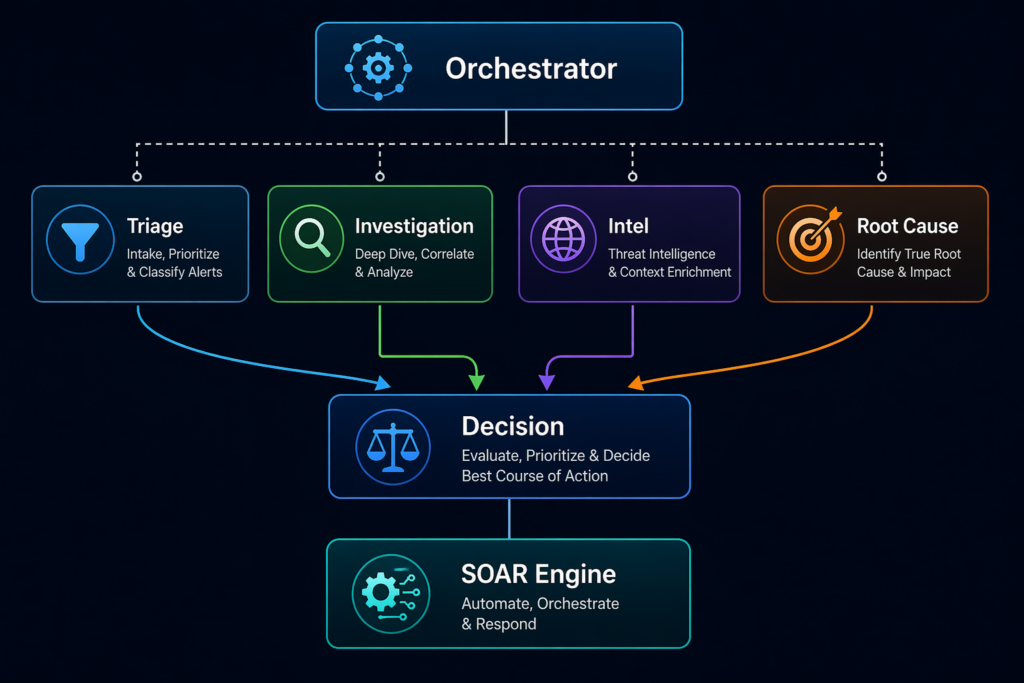 *For detail architecture and solution contact at connect@itechnas.com
How It Works
- Orchestrator unifies all incoming signals
- Triage & Investigation automatically filters and enriches data
- Intelligence Layer provides behavioural insights
- Root Cause Engine identifies the real issue instantly
- Decision Layer enables precise actions
- SOAR Engine executes the response automatically
The Breakthrough: Eliminating L1 and L2
One of the boldest outcomes of this transformation was the complete removal of L1 and L2 layers.
Instead of:
L1 → L2 → L3 → Engineering
The organization now operates on:
Detect → Correlate → Decide → Resolve
Why this works:
- Machines handle repetition and correlation
- Humans focus on decisions and strategy
- Context is preserved end-to-end
👉 This is not downsizing.
👉 This is the evolution of roles.
The Business Impact
The results were transformational:
- 60%+ reduction in MTTR
- 80%+ reduction in alert noise
- Elimination of escalation delays
- Real-time situational awareness
- Significant operational cost optimization
Most importantly:
👉 The organization transitioned from a reactive support model
👉 To a predictive, intelligence-driven command center
The Future: Command Centers, Not Operations Centers
The future is not about improving SOC or optimizing NOC.
It is about eliminating the gap between them.
An Integrated Command Center represents:
- A single source of operational truth
- A unified decision-making engine
- A real-time response capability
Organizations that embrace this model will:
✔️ Respond faster
✔️ Operate leaner
✔️ Scale smarter
✔️ Stay resilient
Final Thought: Redefining Operations with ITechnas
At ITechnas, we don’t just integrate systems.
We redefine how operations function.
We challenge legacy models.
We remove inefficiencies that have become “normal.”
We design for the future, not patch the past.
Because in a world driven by speed and complexity:
The winner is not the one who detects first, but the one who resolves fastest, with clarity.